Wednesday, February 15, 2017

The Sea Hog - An unmanned vehicle for underwater exploration

The Sea Hog

After many weeks of tedious work, our group, Group 2, has finally completed our project which is to create an underwater rover that can take photos and videos underwater.


Introducing Sea Hog

Sea Hog


Promotion video of Sea Hog

Video also available here: https://www.youtube.com/watch?v=dIvg82rqoPQ


Project Statement


There are many water bodies that need to be inspected but are too hazardous for divers to swim in. Our group presents to you the Sea Hog to tackle this challenge. Sea Hog is required to take pictures of the conditions of water bodies and relay the information to the relevant authorities or organisations. In addition, Sea Hog has to be able to dive to a depth of 1.5 meters.

Technical Specifications


Total Weight
3.4kg
Total Volume
24000 cubicmeters
Maximum Size
400 mm X 300 mm X 200 mm
Materials
Acrylic Plate
3D Printer ABS
PVC
Aluminium L-Bars
Aluminium Flat Bar
Electrical Components
Arduino Micro Board
H-bridge L298
DC motor 6.0-15.0V
Arduino Camera
Arduino Joystick
Arduino Board
High Brightness LED
Controls
Arduino Joystick
Function
 Take photos underwater
Operating Voltage
15 V
Camera Output
USB
Maximum Depth
 1.5 meters


For more information, including a technical deep dive into the design specifics of the Sea Hog, please click here.


How well does it work?

Images captured by arduino camera underwater:

Underwater image of swimming pool
Capturing an underwater image of our swimmer
Underwater image of our lecturer

Note that in this case, we used a computer to capture static images from the Sea Hog's onboard camera, via a FTDI adapter and USB connection. The onboard camera also has a composite video output function which you can connect to a TV, however we did not use that feature in our prototype.

To control the movement of the Sea Hog, we used a joystick that switches between two modes. The default mode controls the movement of the Sea Hog in the horizontal plane, allowing it to move forward, as well as turn left and turn right. The other mode, activated by pressing down on the joystick, allows the Sea Hog to surface or submerge underwater.
Who should get this?

There is a very wide market for underwater exploratory vehicles such as the Sea Hog. Since all you need is a computer or TV to see the output from the Sea Hog's camera, and it's all controlled by a single joystick, the sea hog can be used by anyone, from hobbyists and leisure uses, to even governmental research in areas of science and defense. It truly is a product for everyone.


A word of thanks from the team


These past few months have indeed been a long and arduous journey. Throughout the project, we encountered various setbacks, sleepless nights, and other troubles, but it didn't put us down. In fact, as a learned man once said, "what doesn't kill you makes you stronger." Thus, we had learned more than what we could just sitting in a lecture hall and taking examinations, and our chemistry as a team has also improved much from the first day when we came together to begin this project.
So, from the bottom of our hearts, we thank you for viewing our blog and supporting us all this while. We hoped you learnt something useful from us, as we have learnt over the course of this project.

With our greatest thanks,
  • Lucas, Diploma in Electrical and Electronic Engineering, who was responsible for overall electronics design
  • Gabriel, Diploma in Mechanical Engineering, who was responsible for overall mechanical design
  • Pei Yong, Diploma in Electrical and Electronic Engineering, our coding master
  • Joel, from the Diploma in Electrical and Electronic Engineering, who led the effort to chronicle our progress on the project in this blog, and producing the video
  • Keith, from the Diploma in Aerospace Electronics, who performed the important task of performing mechanical calculations

And of course, we couldn't have completed this project without
  • Our lecturers at the Singapore Polytechnic Engineering Academy, whom provided valuable assistance and support in the course of this past few months.


The Sea Hog - Design Specifics

This information is provided as a continuation of our earlier technical review posts, to help as a deep dive into the final decisions made in the design and construction of the Sea Hog.

Design


The Sea Hog's design was given its name as it represents an effective vehicle that operates underwater.

Acrylic side panels

The figure above shows the side panels we implemented for support and stability to the boat's mainframe. T
he panels provide stability as the centre of gravity is below the centre of the vessel, thus making the bottom heavy. In addition, the side panels also act as a bumper in the scenario that Sea Hog knocks into a wall.


LED position in Sea Hog

The design of the main body was purposed at giving our camera a full frontal view underwater and yet be streamlined for least resistance experienced, hence the usage of the PVC body.

The two circles at the top of the main view port. As shown in the above figure on the right, we used LEDs for proper lighting underwater. The LEDs are energy efficient and require only 1.9V for operation.

Position of motors

For the propulsion of the rover we used four 10 centimetre propellers and two 5.5 centimetre propellers.

Motors' Propellers

The 4 upward facing propellers, in yellow, are used to provide upward or downward thrust to float and submerge the boat respectively. The 2 forward facing propellers, in blue, are used for thrust and provide forward motion.

Of course, we have designed the Sea Hog to be completely watertight. In our prototype testing, we found that the waterproofing solution we used (including copious amounts of epoxy, glue and tape) did not allow even a single drop of water to enter the main electrical compartment throughout the testing program. However, we went to great pains to ensure that there was a safe space for water to flow should leaks develop in the body of the Sea Hog.

Electronics


The Arduino camera we are using is displayed below as figure 1. Its dimensions are 26mm X 18mm X 7mm. This is the main camera being used to take photos underwater.

There is also a composite video output on this camera (the lone unsoldered pin, marked CVBS), however in our prototype we did not use this composite video output.


Camera Arduino

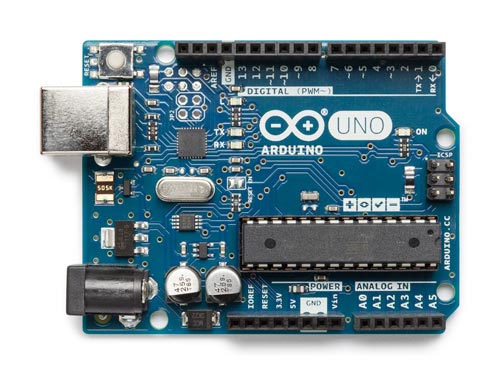
The figure below shows the Arduino board used.

Image result for arduino
Arduino board 

Arduino's dimensions: 100.9mm by 53.4mm

The joystick we used is shown in the figure below.
Joystick
The joystick's dimensions: 38.1 mm X 38.1 mm

The LED we are using are high brightness LED with a potential barrier of 1.9V. The LED are as shown in the figure below.


High Brightness LED
The figure below shows the L298 H bridge motor controller chip that we used.

H-bridge motor controller chip

L298's dimensions: 43.3 mm X 43.3 mm

The figure below shows the arduino micro used for Sea Hog. Its dimensions are 48 mm X 18 mm.
Arduino micro
The figure below shows the motor that our group is using. Its dimensions: 53.5 mm X 32mm X 32mm.

Motor used

The electrical schematics and connections are displayed in the figures below:

Power supply board

Joystick controller circuit

Whole circuit diagram
[ Grey colour wires represent to left-right motors
Red colour wires represent to up-down motors
Black colour wires represent to Gnd ]

The arduino codes used are provided in the link below:

http://pastebin.com/njJLP0ST


Mechanics

Due to high strength to weight ratio aluminium has to offer, aluminium flat and L bars were used to link up the structure of Sea Hog.


Aluminium L bar

Aluminium flat bar

To ensure the main cylinder of the rover was waterproof with the lower possible chance of leaking and collapsing under the pressure the rover has a cylindrical body to distribute the pressure evenly around the cylinder thus lowering the chance for leakages.
   
3D sketch of Sea Hog:


Assembling of Sea Hog:


Written by Pei Yong, Keith and Joel
Technical guidance by Lucas and Gabriel


References


RS (2017) Como Drills DC Motor, 7.98 W, 6 → 15 V dc, 78.4 gcm, 9869 rpm, 2.305mm Shaft Diameter Available at: http://sg.rs-online.com/web/p/dc-motors/2389737/ (Assessed 13 February 2017)